Fantasy RPG Bestiary of Monster Stat Blocks Sorted by Challenge Rating
A bestiary is a working document, not a picture book. Its job is to let a referee pick an opponent, read nine or ten numbers, and run the thing convincingly on the spot. Arranging monster stat blocks by challenge rating is what makes that possible: it puts every option of a given difficulty side by side. Everything that helps at that moment belongs in the entry; everything else belongs in a chapter somewhere behind it.
That is why almost every fantasy rpg bestiary published in the last forty years converges on the same layout. The fields differ, the order barely does, and a referee who can read one collection can read most of them.
What follows is how those entries are built and compared, and which free collections are worth the download. The catalogues themselves are already published at no cost, and named at the end of this page.
What a fantasy rpg bestiary is for
The point of collecting creatures is comparison. On its own, a single entry says very little: 59 hit points is meaningless until you know what else sits at the same difficulty. A bestiary that sorts monster stat blocks by challenge rating turns a list into a measuring instrument, because it puts every option at a given difficulty on the same page.
This is also what makes a bestiary hard to write. Each new entry has to be balanced against every entry already in the book, and against the assumption the system makes about what a party can absorb. Publishers who add creatures without re-reading the neighbours end up with a collection where two things at the same rating are nowhere near the same threat.
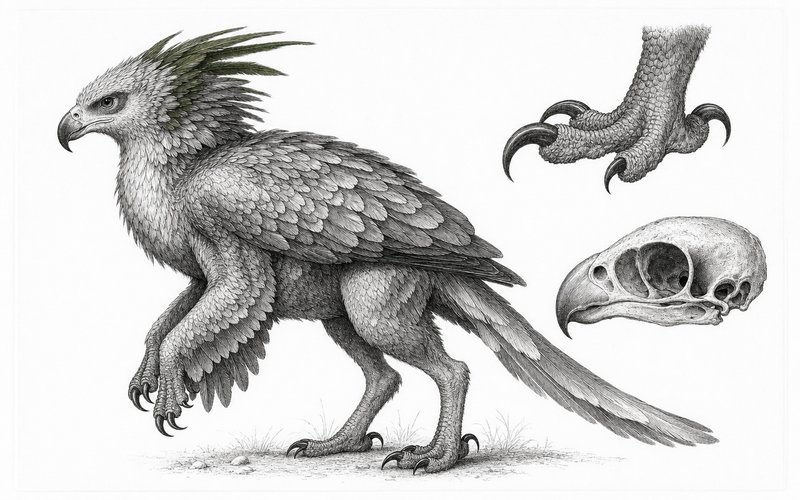
Reading a monster stat block
Start at the bottom. The numbers at the top of a monster stat block tell you whether the creature can be hurt; the abilities at the bottom tell you what the fight is actually about. A giant with 120 hit points and a single club attack is an endurance problem. A creature with half those hit points and an ability that moves characters around the battlefield is a puzzle, and the two will take the same time to resolve for completely different reasons.
The second thing to check is the action economy. One opponent facing four characters loses by arithmetic unless the block compensates, which is why stronger entries carry extra actions, reactions or a swarm of lesser allies. When a solo creature reads as easy despite a high rating, the missing extra actions are usually why.
What challenge rating actually measures
Challenge rating is a compression of two quantities — how much punishment a creature absorbs and how much it inflicts — into one number, calibrated against a party of four at the matching level. It runs from fractions at the bottom to the low thirties at the top.
It is genuinely useful and routinely over-trusted. The rating assumes a party without standout magic items, an ordinary battlefield, and several encounters between rests. It knows nothing about whether the characters can fly when the creature cannot, whether the party has an answer to its one dangerous ability, or whether the terrain hands one side the fight before the first roll. Treat the number as the opening estimate, and the correction is nearly always the terrain. A high-rated brute in an open field against a party that can outrange it. The rating says deadly; the encounter lasts two rounds.
Creature families and why they matter
Grouping by creature type is not taxonomy for its own sake. Type determines what works against a thing: whether it can be charmed, poisoned, frightened or turned, whether it needs to breathe, whether it counts as a valid target for half the spell list. A player who identifies the creature type has learned more, tactically, than one who learned its hit points.
It also keeps a collection honest. When every second creature is an aberration with psychic damage and a tentacle, the book has a voice problem, and grouping by type is the quickest way to see it.
Comparing monster stat blocks by challenge rating across systems
Difficulty scales do not translate. Pathfinder 2e rates creatures by level against a tight encounter budget; older and old-school-adjacent games often use hit dice and expect the referee to judge the rest; several modern systems dispense with a rating entirely and describe the intended fiction instead.
If you need to move a creature between systems, ignore the label and rebuild from behaviour: how many rounds it should survive, how much it should threaten per round, and the one thing it does that nothing else at that tier does. Sorting monster stat blocks by challenge rating only works inside the system that defined the rating.
Where to find a free fantasy rpg bestiary
Several substantial collections cost nothing. Basic Fantasy RPG releases its creature list openly alongside the rest of the game. The 5e system reference document has been available under a Creative Commons Attribution licence since January 2023, which makes its creature catalogue freely reusable with credit. Archives of Nethys publishes the full Pathfinder catalogue online as the publisher's own reference.
Between them, a free fantasy rpg bestiary will cover the ordinary run of play: the goblins, the undead, the animals a druid might reasonably become. What the free collections rarely supply is the specific creature your campaign needs, which is where writing your own entry starts to look less like work and more like the point.
Writing an entry that survives play
Build the ability first and the numbers second. A creature is memorable because of what it does, and the defences exist to give it long enough to do it. If you cannot say in one sentence what the fight is about, no amount of hit points will fix the entry.
Then playtest it once and cut something. Nearly every home-written creature arrives with one ability too many, and the first session shows exactly which one never came up.
Common questions
What belongs in a monster stat block?
Defences, offence, movement, a difficulty rating, and whatever the creature does that a plain attack cannot express. Everything else is flavour text and belongs outside the block. A block that will not fit on a card is usually describing two creatures.
Is challenge rating a reliable difficulty measure?
It is a starting point, not a verdict. Challenge rating assumes a party of four at that level, roughly six or seven encounters between long rests, no unusual terrain and no standout magic items. Break any of those assumptions and the rating drifts, sometimes badly.
Where can I find a free fantasy rpg bestiary?
Basic Fantasy RPG publishes its entire creature list at no cost, the 5e SRD has been available under a Creative Commons Attribution licence since January 2023, and Archives of Nethys hosts the full Pathfinder catalogue online. Between them a free fantasy rpg bestiary covers most of what a table needs.
How do I sort monster stat blocks by challenge rating across systems?
You cannot do it directly, because the scales are not comparable. Convert to a common yardstick instead — how many rounds the creature survives, and how much damage it deals per round, against a party the system considers its equal.
Should a bestiary entry include tactics?
Two or three lines, yes. A creature that opens with its strongest ability plays very differently from one that circles first, and the numbers alone will not tell a referee which it is.